VW/Audi EA888 family Engine Guide: Specs, Reliability and Ownership Reality
There’s a full video walkthrough for this topic—hit play when you’re ready, or scroll on for the written guide.
Open in YouTube · If the player does not load, your browser or region may block embedded video—use the link.
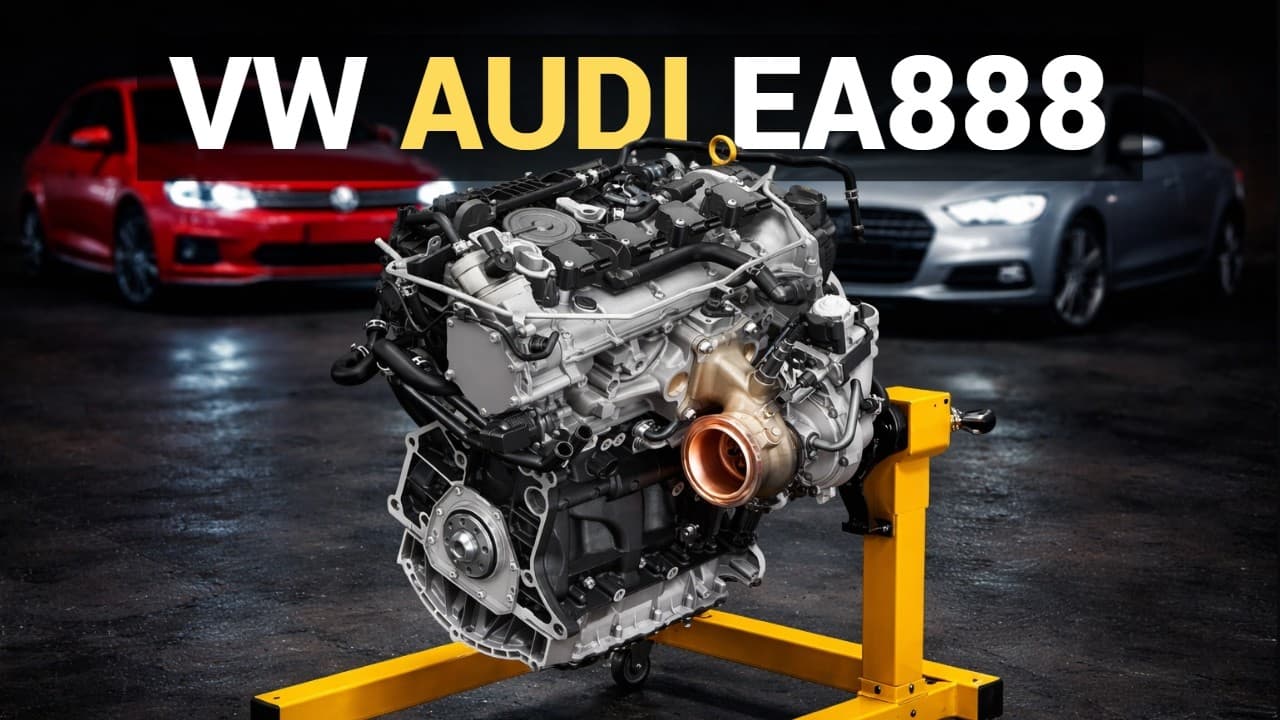
A complete guide to the VW/Audi EA888 family: design, applications, reliability, common problems, maintenance priorities and used-buying advice.
The VW/Audi EA888 family attracts attention because it sits at the intersection of performance, used-car value and long-term maintenance. It is a 1.8- and 2.0-liter turbocharged gasoline inline-four used during late 2000s to present, most commonly associated with Golf GTI/R, Jetta/GLI, Tiguan, Passat and many Audi A3/A4/A5/Q models. That one sentence explains the hardware, but it does not answer the question owners actually ask: is it a smart engine to own once the warranty and the easy miles are gone?
The short answer is that maintenance history matters more than internet reputation. The engine's best qualities include broad torque, excellent parts availability, and strong tuning potential. Its recurring watch items include water-pump and thermostat housing leaks, PCV faults, intake-valve carbon on direct-injection versions, and generation-specific oil consumption or timing concerns. None of those items should be turned into a universal failure claim. They are a better starting point for inspection, diagnosis and budgeting. This guide focuses on understanding the engine as a complete ownership package and separates documented design facts from owner anecdotes.
What is the VW/Audi EA888 family?
The VW/Audi EA888 family is a 1.8- and 2.0-liter turbocharged gasoline inline-four. It appeared across Golf GTI/R, Jetta/GLI, Tiguan, Passat and many Audi A3/A4/A5/Q models, which means specifications, emissions hardware, cooling layouts and software calibrations can vary by market and model year. Always identify the exact engine code and VIN before ordering parts or applying an interval found online.
The broad engineering brief was to deliver useful torque without sacrificing efficiency. In practice, owners notice broad torque, excellent parts availability, and strong tuning potential. Those strengths are why a well-kept example can still feel modern even after years of use. They also explain why modified cars are common: a responsive factory engine makes a tempting base for more boost or more aggressive software.
Why owners research this engine
Search results tend to collapse every version into one story. That is risky. A recall can apply only to a production window. A technical bulletin can describe a repair method without proving a failure rate. A forum thread can reveal a useful symptom pattern while still representing a self-selected group of owners who arrived because something went wrong.
Our approach is to use manufacturer material and NHTSA records for verifiable design or campaign information, then use owner communities for context about how symptoms appear in daily driving. The owner reports are useful, but they are not statistical proof. That distinction keeps the advice practical without turning it into fear-based content.
The strengths that matter in the real world
The first strength is broad torque. It affects more than a spec sheet: it shapes how relaxed the engine feels in traffic and how often a driver needs to chase revs. The second is excellent parts availability, which can make a large difference once the car leaves the dealer network. The third is strong tuning potential.
A strong engine core does not make the surrounding system maintenance-free. Cooling modules, ventilation hardware, sensors, gaskets and emissions components live through thousands of heat cycles. Many expensive ownership stories begin with a small warning that was ignored: a slow coolant loss, an occasional long crank, a new oil smell or an intermittent misfire.
Common problems and what they really mean
The most useful problem list is one that helps diagnosis rather than panic:
- Water-pump and thermostat housing leaks: treat this as a diagnostic lead, not proof that every engine will fail the same way.
- PCV faults: treat this as a diagnostic lead, not proof that every engine will fail the same way.
- Intake-valve carbon on direct-injection versions: treat this as a diagnostic lead, not proof that every engine will fail the same way.
- Generation-specific oil consumption or timing concerns: treat this as a diagnostic lead, not proof that every engine will fail the same way.
These symptoms overlap. A rough idle might come from ignition, a vacuum leak, fuel delivery, deposits or software. A low-coolant warning may come from a cap, hose, pump, module or an internal leak. Parts-cannon repairs are especially wasteful on modern engines because one failed seal can trigger several secondary fault codes.
Warning signs worth acting on
Pay attention to repeatable changes rather than one isolated moment. A cold-start rattle that appears every morning, coolant that needs topping up twice, a misfire that follows one cylinder or oil accumulating near the accessory belt all deserve diagnosis. Record when the symptom happens, capture fault codes before clearing them and photograph fluid residue before cleaning it away.
Stop driving if oil pressure is lost, temperature rises abnormally, coolant empties quickly, the engine knocks, or the check-engine light flashes under load. A tow bill is cheaper than converting a serviceable problem into an overheated engine, damaged catalyst or failed bearing.
Generation, model year and market differences
Engine-family names are useful search terms, but they are not complete parts catalogues. Manufacturers revise pumps, pistons, injectors, ventilation hardware, software and emissions equipment during a production run. The same engine name can also sit longitudinally in one car and transversely in another, changing access and labor time. U.S. emissions variants may carry different hardware from European versions discussed in a video or forum thread.
Before acting on any common-problem list, record the VIN, production month, engine code and installed part number. Check open campaigns through the manufacturer and NHTSA. A later replacement part can look similar while incorporating a revised material or connection. This is why a precise invoice is more valuable than a seller saying “the water pump was done.” The invoice shows which part, when, at what mileage and what else was replaced.
For the same reason, horsepower figures should be attached to a model and year rather than repeated as one universal EA888 specification. The ownership conclusions in this guide concern the family pattern; the exact output and service procedure must come from vehicle-specific information.
Maintenance that changes the outcome
There is no single internet schedule that fits every VW/Audi EA888 family. Use the vehicle's official maintenance information as the baseline, shorten service intervals when the car sees severe use, and do not confuse “lifetime fluid” marketing with a promise that a component never benefits from inspection.
- Use oil carrying the exact approval required for the VIN and market.
- Check fluid levels between services; a warning light should not be the measuring tool.
- Give a heavily loaded turbocharged engine time to reach stable oil temperature.
- Replace leaking cooling parts before repeated low-coolant events create air pockets or overheating.
- On a tuned car, treat spark plugs, fuel quality, datalogs and heat management as part of the modification.
Building a realistic first-year budget
Do not spend the entire purchase budget on the purchase price. Reserve money for a baseline service and the faults found during inspection. On an older car, tires, battery condition, brakes, suspension, transmission or all-wheel-drive service can matter as much as the engine. A cheap example becomes expensive when several ordinary age-related jobs arrive together.
Prioritize work in this order: safety, active fluid loss, faults that can damage the engine or emissions system, overdue maintenance, then comfort and cosmetic items. Ask the specialist which findings are urgent, which can be monitored and which are simply normal seepage. That conversation turns a frightening estimate into a plan. It also prevents cosmetic modifications from consuming the reserve that should protect the powertrain.
What high mileage changes
At 100,000 miles, the odometer is less informative than the service file. Highway mileage with documented oil changes can be easier on an engine than half as many short urban trips. Heat cycles age plastic and rubber even when annual mileage is low. The correct question is therefore not “is this mileage too high?” but “which age- and use-related work has already been completed properly?”
A high-mileage example can still be a good purchase when it starts cleanly, holds fluids, has stable fuel trims, reaches and maintains operating temperature, and comes with evidence rather than promises. A low-mileage car can be a bad purchase if it sat, ran on overdue oil, was tuned carelessly or has a cooling problem hidden by a recent wash.
The Haris Cars inspection checklist
- Identify the exact generation and engine code.
- Pressure-test the cooling system.
- Check fuel trims and misfires.
- Inspect modification history.
Add a proper pre-purchase inspection by a specialist who knows the engine family. Ask for a cold start, a full-system scan, a cooling-system pressure test when relevant and an underbody inspection. Generic used-car inspections often miss engine-specific data and hidden fluid residue.
What owners say—and how to use it
Owner communities repeatedly show two truths at once. Some drivers cover very high mileage with routine service, while others experience an expensive supporting-component failure much earlier. That spread is normal for a mass-produced engine used across different vehicles, climates and driving patterns.
Use anecdotes to learn vocabulary and symptoms. If several owners describe the same leak path or sound, it becomes a useful inspection lead. Do not use one post to predict that your car will fail at the same mileage. Verify the claim against campaigns, service information, physical inspection and the exact production date.
Repair cost and DIY reality
Cost depends more on access and collateral work than the price of one part. A modest gasket can require hours of disassembly. A cooling repair may justify replacing age-matched hoses while access is open, but replacing every surrounding part without inspection can waste money. Ask a shop to separate the estimate into confirmed failure, sensible while-you-are-there work and optional preventive work.
DIY owners should use proper torque data, fluid filling procedures and scan-tool functions. Modern cooling systems may require vacuum filling or electronic bleeding. Fuel systems can retain dangerous pressure. If the procedure is unclear, paying for correct diagnosis is usually the cheapest first step.
Verdict
The VW/Audi EA888 family should be judged as a system, not a meme. Its case for ownership rests on broad torque, excellent parts availability, and strong tuning potential. The sensible cautions are water-pump and thermostat housing leaks, PCV faults, intake-valve carbon on direct-injection versions, and generation-specific oil consumption or timing concerns. With records, a clean inspection and realistic reserves for age-related work, it can be a rewarding engine. Without those things, even a famous “reliable” engine can become an expensive lesson.
FAQ
Is the VW/Audi EA888 family reliable?
Broadly, it can be reliable when maintained correctly, but “reliable” does not mean free of supporting-component failures. Exact generation, model year, use and service history matter more than the badge alone.
What should I check first on a used example?
Start with identify the exact generation and engine code, then pressure-test the cooling system. Follow with a full fault-code scan and a cold-start inspection. Do not accept cleared codes as proof that a fault is fixed.
Is a modified VW/Audi EA888 family automatically a bad buy?
No, but it requires more evidence. A conservative calibration, correct fuel, logs and frequent maintenance are very different from an unknown tune installed to help sell the car.
Can preventive maintenance stop every failure?
No. It reduces risk and catches developing problems, but parts can still fail. The goal is to prevent a small leak or intermittent fault from becoming major engine damage.
Sources and owner context
Specifications and campaigns vary by VIN. These are starting points used for this guide; always check the exact vehicle:
Related articles
 High-Mileage Reliability
VW/Audi EA888 family After 100,000 Miles: Reliable or a Money Pit?
What VW/Audi EA888 family ownership really looks like beyond 100,000 miles, including the parts that last, the failures owners report and a smart inspection plan.
9 min read- Maintenance & Problems
VW/Audi EA888 family Common Problems: What Fails and What to Check
A practical, evidence-led guide to VW/Audi EA888 family problems, warning signs, diagnosis and the checks that matter before spending money.
9 min read  Engine Guides
Volkswagen EA211 TSI Engine Guide: Specs, Reliability and Ownership Reality
A complete guide to the Volkswagen EA211 TSI: design, applications, reliability, common problems, maintenance priorities and used-buying advice.
9 min read