Engine Guides · BMW
BMW N55 Engine Guide: Specs, Problems and Buying Advice
BMW N55 3.0 turbo six explained: verified specs by model, the VANOS recall, common leaks and water pump faults, N54 differences and a used-car checklist.
11 minBy Haris Cars
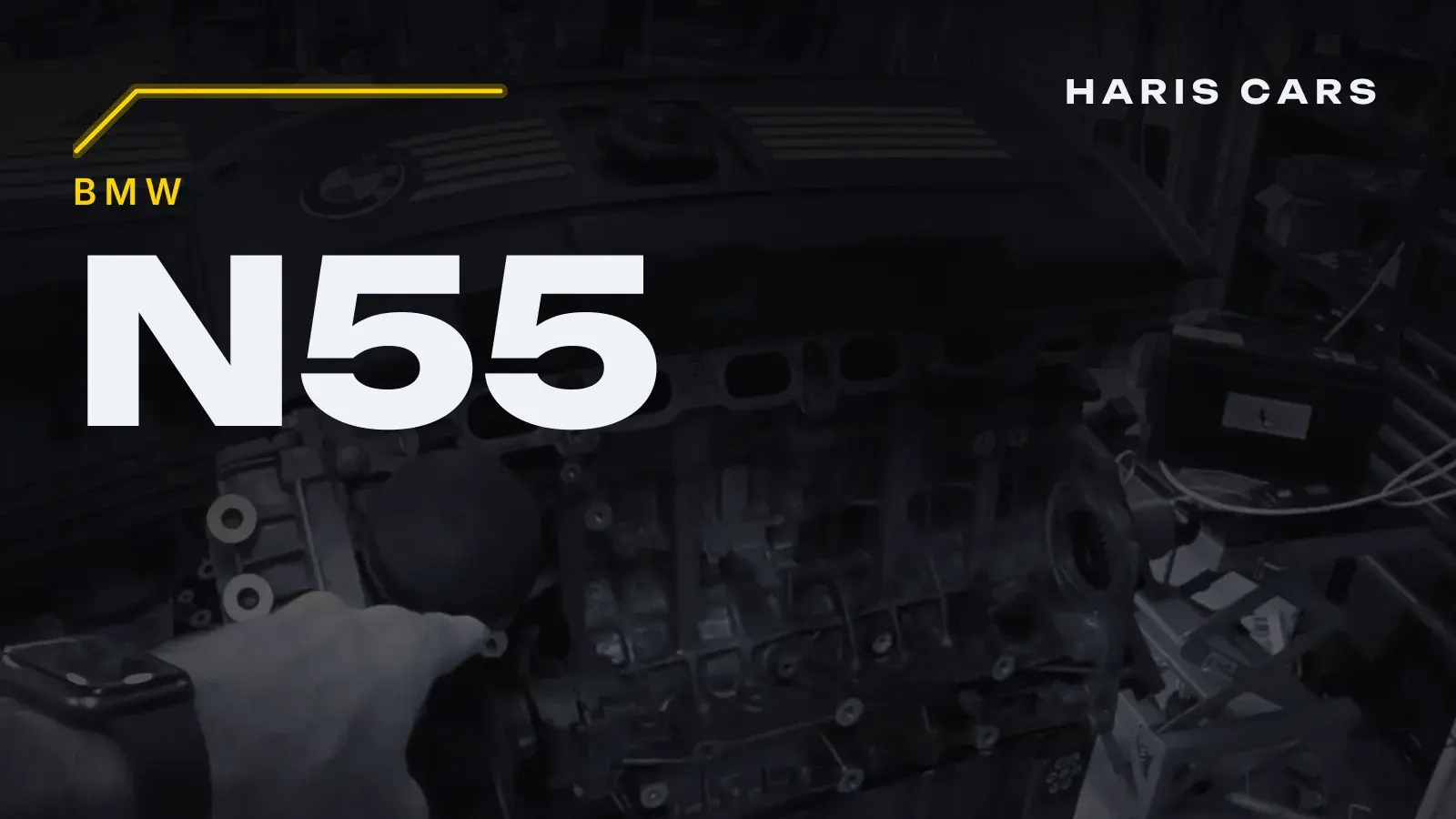
The BMW N55 is a 3.0-liter turbocharged inline-six with a single twin-scroll turbo, direct injection and Valvetronic. It powered BMW's 35i models from 2009 until the B58 took over, plus the M235i and the original M2. It is a sound, smooth engine whose weak points are well known and mostly bolt-on: oil leaks, the electric water pump, the plastic charge pipe and, on early cars, the VANOS bolts covered by a recall. It suits buyers who want six-cylinder BMW performance without the N54's twin-turbo complexity, as long as they budget for leak and cooling-system repairs as it ages.
N55 at a glance
The N55 keeps the N54's 3.0-liter dimensions but replaces its twin turbos with one twin-scroll unit and adds Valvetronic variable valve lift.
- Displacement: 2,979 cc.
- Bore × stroke: 84.0 × 89.6 mm.
- Compression ratio: 10.2:1.
- Block: die-cast aluminum crankcase with a bedplate and cast-iron cylinder liners.
- Crankshaft: cast iron, 20.3 kg, about 3 kg lighter than the N54's.
- Valvetrain: DOHC, 24 valves, chain-driven. Double VANOS varies intake and exhaust timing, and third-generation Valvetronic varies intake valve lift so the engine needs no conventional throttle.
- Induction: one twin-scroll turbocharger. Cylinders 1–3 feed one scroll and 4–6 the other. The exhaust manifold and turbo are welded into one part.
- Injection: direct injection with Bosch HDEV5.2 solenoid injectors at up to 200 bar, fed by a three-piston high-pressure pump.
- Oiling and cooling: volume-controlled oil pump and an electric water pump.
- Years: production began in 2009. The 535i Gran Turismo was the first model to use it.
Output depends on the model and market. Here are the figures we could confirm:
- 535i GT launch rating (Europe, 2009): 306 hp and 400 Nm from 1,200 rpm.
- 2011 335i (E90, US): 300 hp and 300 lb-ft from 1,200 to 5,000 rpm.
- 2012 335i (F30, US): 300 hp at 5,800 rpm and 300 lb-ft from 1,200 to 5,000 rpm.
- 135is (US): 320 hp and 317 lb-ft.
- 2014 M235i (US): 320 hp and 330 lb-ft.
- 2016 M2 (US): 365 hp at 6,500 rpm and 343 lb-ft from 1,400 to 5,560 rpm. An overboost function briefly raises torque to 369 lb-ft.
Where you'll find the N55
In the US, almost any BMW badged 35i from about 2011 through the late 2010s has an N55. The 335is and Z4 sDrive35is are exceptions: they used a higher-output N54. Confirm the engine code on any car you are considering, especially around the 2010–2011 changeover from the N54.
- Early cars: BMW's 2014 VANOS recall covers N55-equipped models built from September 2009 to November 2011. That list confirms these early applications: the E82/E88 135i, E90/E92/E93 335i, E70 X5 and E71 X6 35i, F07 535i Gran Turismo, F10 535i, ActiveHybrid 5, F12/F13 640i, and F25 X3 xDrive35i.
- F-series cars: the F30/F31/F34 335i, F32/F33/F36 435i, F15 X5 and F16 X6 35i, and F26 X4 xDrive35i. Parts suppliers list shared N55 hardware for these cars, such as the genuine BMW electronic wastegate actuator.
- Performance versions: the 135is, the F22/F23 M235i, the X4 M40i and the 2016–2018 F87 M2.
- End of the line: BMW began phasing the N55 out after the B58 arrived in 2015. For 2019, it replaced the N55-powered M2 with the M2 Competition, which uses an engine based on the M3/M4 unit.
Versions and revisions
The N55 changed in small steps rather than in a single "TU" update. Most of the changes affect which replacement parts fit.
- Base engine: BMW's training material covers the N55B30M0. This standard engine is rated around 300 hp in US 35i models.
- Higher-output versions: the 640i, 135is, M235i and ActiveHybrid models used higher-rated versions. Ward's described the 640i engine as the "N55HP" when it was announced.
- M2 version: BMW says the M2 engine took its pistons and crankshaft main bearing shells from the M3/M4 engine, and it uses a modified oil sump.
- VANOS hardware: cars built from September 2009 to November 2011 were recalled for VANOS gear bolts. BMW says cars that already had both VANOS units or a complete engine replaced on or after September 1, 2012, have compliant parts.
- Wastegate: BMW's launch training material shows a vacuum-operated wastegate controlled by an electro-pneumatic pressure converter. Later F-chassis N55s use an electronic wastegate actuator, so confirm the production date before you order parts.
- High-pressure fuel pump: BMW's training material says the early N55 pump is the same design as the N54's. Specialist parts supplier FCP Euro says a revised tappet-style pump arrived for the 2014 model year.
- Injectors: FCP Euro says injectors fitted before January 2011 use different hold-downs and a two-piece well, so early and late injectors need different removal tools.
How the N55 differs from the N54
The N55 is the N54's direct successor. It is cheaper to build and simpler to maintain, with the same displacement and nearly the same rated output. BMW's own training introduction says the redesign made it possible to use one turbocharger while keeping the technical data "virtually the same." The main changes:
- Turbocharging: the N54 has two small turbos. The N55 has one twin-scroll turbo, which Ward's described as smaller, lighter, cheaper, lower in friction and quicker to respond.
- Injectors: the N54 uses piezo injectors. The N55 switched to less expensive Bosch solenoid injectors, and a BMW engineer told Ward's that BMW wasn't using piezo technology's full potential.
- Valvetronic: BMW says the N55 was the first BMW six-cylinder to combine direct injection, turbocharging and Valvetronic. BMW claims the combination cuts fuel consumption and CO2 by 3–6%.
- Bottom end: the N55 has a lighter crankshaft and new oil-return channels that keep returning oil away from the crank to cut churning losses.
- Same output: in the 2011 335i, both engines were rated at 300 hp and 300 lb-ft.
The N54's reputation for big tuning gains on stock turbos comes from enthusiast experience rather than BMW data, and so does the N55's reputation as the easier daily. Our BMW N54 engine guide covers the older engine's fuel pump, injector and wastegate history in full.
Known problems and what to check
The N55's one safety recall covers VANOS bolts on early engines. Everything else on this list comes from owner and specialist reports, not BMW campaigns. Most of it is leaks and cooling parts, not internal failures.
VANOS gear bolts (recall 14V-176)
- Symptoms: engine emergency mode with the malfunction light permanently on.
- Cause: BMW's bulletin says the VANOS adjustment units can develop internal oil leakage and stop adjusting quickly enough. The repair focuses on loose or broken gear bolts.
- Fix: replace the VANOS gear bolts. If any bolts are loose or broken, replace that whole VANOS unit and recover any broken bolt heads from the engine.
- Confirm: check for a punched code 684 on the recall label on the B-pillar, or run the VIN at nhtsa.gov/recalls.
Oil leaks: valve cover, oil filter housing gasket, oil pan
- Valve cover: the N55's crankcase ventilation, including its non-return valves and pressure control valve, is built into the plastic cylinder head cover. FCP Euro reports that the cover becomes brittle with heat cycling. A failed ventilation valve or a cracked cover means replacing the whole cover. Symptoms include oil on the exhaust manifold and, if the cover cracks, rough running from a vacuum leak.
- Oil filter housing gasket: the filter housing is made of Duroplast, a thermoset plastic, and its rubber seals shrink with heat. Specialists warn that oil from this leak can reach the serpentine belt. A belt that slips or shreds can be pulled past the front crank seal.
- Oil pan gasket: heat cycling can separate the rubber from the gasket's steel carrier, causing seepage that grows into drips.
Electric water pump and thermostat
- Symptoms: overheating warnings once the pump stops circulating coolant.
- Cause: the N55 uses an electric water pump. Specialists report that the pump's internal control electronics are the usual failure point, and they typically replace the thermostat at the same time.
- Confirm: diagnose before replacing anything. FCP Euro notes that CAN bus faults can mimic a failed pump.
Charge pipe and coolant flange
- Charge pipe: the plastic pipe from the turbo to the intercooler becomes brittle with heat and can crack or break during other work. A cracked pipe leaks boost. FCP Euro suggests an upgraded aftermarket pipe as the replacement.
- Coolant flange: owners commonly report that the plastic coolant flange (nicknamed the "Mickey Mouse" flange) cracks and dumps coolant without warning.
High-pressure fuel pump and injectors
- Symptoms: loss of fuel pressure, with fuel-pressure fault codes and reduced power.
- Early pump: because the first N55 pump shared the N54's design, specialists report the same internal seal failures. BMW's extended HPFP warranty was written for N54 models, and we found no equivalent N55 program. Our N54 HPFP history explains that coverage.
- Injectors: the solenoid injectors are considered more durable than the N54's piezo units, but they do still fail and are replaced individually.
Valvetronic and crank bolt (lower priority)
- Valvetronic oil squirter: FCP Euro reports that sludge can block the oil jet that lubricates the Valvetronic eccentric shaft and gear, accelerating wear. Clean oil is the prevention.
- Crankshaft bolt: the crank bolt alone clamps the timing sprocket. Specialists recommend a "capture" kit on heavily tuned engines, because a slipped sprocket can let valves hit pistons.
Buying checklist
Look for leaks, cooling-system history and proof that the recall was done. Most N55 problems are visible on a lift or in the records.
- Recall: on any car built from September 2009 to November 2011, confirm recall 14V-176 was completed by checking the VIN at nhtsa.gov/recalls or the B-pillar label.
- Underneath: look for oil on the exhaust manifold, around the oil filter housing at the front of the engine, along the oil pan rail and on the belt. A wet belt is a stop-and-fix item, not a negotiating point.
- Cooling history: ask whether the electric water pump and thermostat have been replaced, and when. Check the coolant level and look for dried coolant residue around the plastic coolant fittings.
- Cold start and idle: idle should be smooth with no chain or VANOS rattle. Run a full scan for VANOS, fuel pressure, misfire, boost and coolant pump codes. Our OBD-II buying guide walks through it.
- Boost: on the test drive, pull from about 2,000 rpm in a high gear. Hesitation, a hiss or a sudden power cut points to the charge pipe or boost control.
- Modifications: ask about tunes, downpipes and charge pipes. A tuned N55 isn't automatically a bad buy, but it changes how hard the turbo, fuel system and crank bolt have worked.
Maintenance that matters
Oil changes with the right oil, a healthy cooling system and fixing leaks early do more for an N55 than any upgrade.
- Oil spec: BMW's 3 Series owner's manual lists BMW Longlife-01 or Longlife-01 FE for gasoline engines, in SAE 0W-40, 0W-30, 5W-40 or 5W-30. Up to 1 US quart of API SM or better can be added if no approved oil is available. Our BMW Longlife oil guide explains the approvals.
- Interval: the car's Condition Based Service display sets the factory interval. FCP Euro recommends changing oil about every 5,000 miles, partly to keep the Valvetronic oil jet clear. That is a specialist recommendation, not BMW's.
- Spark plugs: FCP Euro gives BMW's interval for a stock engine as 60,000 miles and suggests shorter intervals and colder plugs on tuned engines.
- After oiling or timing work: FCP Euro cites a BMW procedure for re-priming the oil system before first start after valvetrain or timing work.
- Intake carbon: the N55 is direct-injection only, so deposits build up on the intake valves. Our carbon buildup guide covers symptoms and walnut blasting.
High-mileage outlook
A high-mileage N55 is usually limited by its gaskets and plastic parts rather than by its crank, rods or bearings. Apart from the early VANOS bolt recall, we found no BMW campaign covering the N55's block, crankshaft or timing drive. The leaks, the electric water pump and the plastic cooling and intake parts do accumulate, and they tend to arrive together. When judging a 120,000-mile car, look for evidence that they have already been dealt with. A dry engine with a recent pump, thermostat, valve cover and filter housing gasket is a better buy than a lower-mileage car that has never had them done. We won't give a failure percentage, because no reliable public data exists. For how its successor compares, see our BMW B58 guide.
Frequently asked questions
Is the BMW N55 a reliable engine?
Generally, yes. Its common problems are oil leaks, the electric water pump and thermostat, the plastic charge pipe and coolant flange, and the early VANOS bolt recall. Internal failures on stock, well-maintained engines are not a documented pattern.
What is the difference between the N54 and N55?
The N55 replaces the N54's twin turbos with one twin-scroll turbo and its piezo injectors with Bosch solenoid injectors. It adds Valvetronic variable valve lift and uses a lighter crankshaft, while keeping the same 3.0-liter displacement and, in the 335i, the same 300 hp and 300 lb-ft rating.
Which BMWs have the N55 engine?
Most US 35i models from about 2011 through the late 2010s: the 135i, 335i (E9x and F3x), 435i, 535i and 535i GT, 640i, X3 xDrive35i, X4 xDrive35i, and X5/X6 35i. It was also used in the M235i, X4 M40i and 2016–2018 M2.
What oil does the N55 use?
BMW specifies an oil approved to BMW Longlife-01 or Longlife-01 FE for its gasoline engines in North America, in grades such as 0W-30 or 5W-30. Always check the owner's manual for your car.
Does the N55 have a timing chain?
Yes. The N55 uses timing chains, with no scheduled replacement interval. On heavily tuned engines, specialists also look at the crankshaft bolt that clamps the timing sprocket.
Sources
- BMW Technical Training: ST501 N55 Engine
- BMW Technical Training: ST1313 F22 Complete Vehicle
- NHTSA / BMW NA: SI B11 08 14, Recall Campaign 14V-176, N55 VANOS gear bolts
- BMW Group Newsroom: The all-new 2016 BMW M2
- BMW Group Newsroom: The first-ever 2019 BMW M2 Competition
- WardsAuto: BMW's Newest I-6 Better, Not Bigger
- WardsAuto: BMW 2-Series a Winner of a Bimmer
- WardsAuto: BMW Sees M2 as New Benchmark
- Automotive Fleet: BMW Introduces New 3 Series Sedan
- Paul Tan: New BMW N55 single turbo Valvetronic engine (2009)
- Paul Tan: BMW 335i Sport (F30) specifications
- NHTSA / BMW NA: N54 diagnosis and extended high-pressure fuel pump warranty bulletin
- BMW 3 Series Owner's Manual (2015 edition): engine oil
- FCP Euro: The Definitive Guide to the BMW N55 Engine
- BimmerWorld: Genuine BMW Electronic Wastegate Actuator for N55 Engine
- Wikipedia: BMW N55
Keep reading
Related posts
Engine Guides
BMW N54 Engine Guide: Specs, Problems and Buying Advice
BMW N54 twin-turbo six explained: verified specs by model, every BMW bulletin on HPFP, injectors, wastegates and water pump, plus a used-car checklist.
BMW14 minVideo
Owner Guides
BMW LL-01 vs LL-04 vs LL-17 FE+: Which Oil Does Your BMW Need?
BMW Longlife oils decoded: what LL-01, LL-04, LL-12 FE, LL-14 FE+, LL-17 FE+ and LL-19 FE mean, which engines take which, and US vs EU rules.
BMW8 min
Engine Guides
BMW S58 Engine Guide: Specs, Problems and Buying Advice
BMW S58 explained: specs and power for each M3, M4, M2 and X3 M, the bearing-shell campaigns, M Ignite, and what to check before buying a used one.
BMW12 minVideo
Engine Guides
BMW B38 Engine Guide: Specs, Problems and Buying Advice
BMW and MINI B38 1.5 three-cylinder: verified specs by model, the 2015 thrust bearing fix, leaks, recalls, oil spec and a used-car checklist.
BMW12 minVideo
Engine Guides
BMW B47 Diesel Guide: Specs, EGR Recall and Problems
BMW B47 2.0 diesel explained: verified specs by model, the EGR cooler recall and its scope, damper and DPF issues, and a used-buyer checklist.
BMW12 minVideo
Engine Guides
BMW B58 Engine Guide: Specs, Problems and Buying Advice
BMW B58 3.0 turbo six explained: specs by version (B58, TU, TU2), the Supra link, known problems backed by BMW bulletins, and used-buyer checks.
BMW14 minVideo

Lights on.
Subscribe.
Engine walkthroughs for BMW, VW, Audi and Mercedes-Benz owners, on YouTube at @HarisCars.
Subscribe on YouTube